Volunteering is at the core of everything we do for wildlife, people and places. We value every volunteer for their contributions however big or small. We also know volunteering can help people to take action for nature and themselves. Over 50 people volunteer at Wild Ingleborough and Paul Whitaker shares his volunteering experience below.
A Wild Ingleborough Volunteer’s Story

Volunteering is at the heart of everything we do for nature, people and places. We spoke to one of our volunteers, Paul, about his experience with Wild Ingleborough and his connection to the outdoors—here’s what he shared with us.

Credit: Jeanne Godfrey
Volunteers name: Paul Whitaker
Paul started volunteering with Wild Ingleborough in November 2021.
He supports on nursery and practical conservation task days, from potting on seedlings to drystone walling.
What are your interests in wildlife?
I have always enjoyed being outside surrounded by the sights and sounds of wildlife. The sight of huge bumble bees burrowing head first in melancholy thistle (Cirsium heterophyllum) flowerheads and the bubbling call of a curlew (Numenius arquata) flying overhead, are just two examples of how I can be stopped in my tracks by the beauty of nature around us.
In recent years, I have become more aware of the decline of curlews and other local flora and fauna. I have thought more about the options and what I can actually do to help nature recover.
Fortunately, there are opportunities for volunteering, fundraising and learning new skills at workshop events available all year round from conservation organisations like the Yorkshire Wildlife Trust (YWT).
Why did you start volunteering for Wild Ingleborough?
Living in the ‘green triangle’ of South Cumbria, North Lancashire and North Yorkshire, I have lots of volunteering opportunities for lots of different conservation organisations and groups. The distant and distinctive shape of Ingleborough is always an ever-present backdrop.
I was therefore very interested to read about how Yorkshire Wildlife Trust, working many partners including Natural England, WWF, United Bank of Carbon, Leeds University and The Woodland Trust wanted to undertake landscape-scale restoration to create a wilder Ingleborough.
The sheer scale of this ‘flagship project’ was such that I wanted to be involved and ‘do my bit’. Wild Ingleborough has recently even had a royal seal of approval, becoming part of King’s Series of National Nature Reserves.
I registered in 2021 and have continued volunteering with Wild Ingleborough ever since. This is not only due to the variety of volunteering opportunities available, but also to the sheer beauty and variety of Ingleborough landscapes. Volunteering at Wild Ingleborough can offer you everything. There is grassland, bog, wood pasture, limestone pavement and rugged fell – from the river to the summit ridge of Ingleborough and 7 nature reserves in between.
Despite the remoteness of Ingleborough, public transport connections are surprisingly good… a short ramble from many reserves and the upland plant nursery, Ribblehead train station transports volunteers from as far as Skipton, Leeds and even York. ‘The Station Inn’ next door to the station is the perfect location to wait for your train home.
When did you first volunteer for Wild Ingleborough?
November 2021, at a tree planting session on Ingleborough National Nature Reserve, on the western slope of Ingleborough.
What volunteering do you do with Wild Ingleborough?
Conservation task days are as varied as the weather up there and opportunities are available all year round. Spring/summer activities have involved dry stone walling, upland wildflower nursery work, thistle management and reserve maintenance. Whilst autumn/winter activities have included cutting willow pegs for planting, wildflower plug planting, tree planting and tree maintenance.
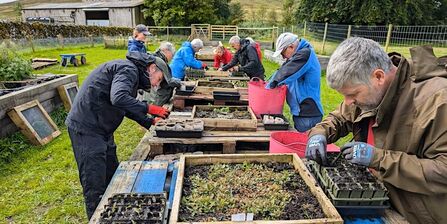
Since 2023 I am one of six volunteers enrolled on the upland nursery plant grower project. Every autumn the Wild Ingleborough staff give us locally sourced wildflower seeds, trays and compost. Green-fingers crossed, the following spring we give them back plug plants that will eventually be planted across the Wild Ingleborough reserves.
Species successfully grown by the nursery plant grower volunteers include betony, globeflower, melancholy thistle, ragged robin, sneezewort, purple saxifrage and yellow saxifrage.
In 2024, 4,509 wildflower seedlings were potted on by Wild Ingleborough volunteers in the upland plant nursery in just 3 days!
In the 2025 growing season, Wild Ingleborough staff and volunteers potted on a total of 17,500 plants of 21 species with 345 volunteer hours. 2,200 of those were tree/shrub species, mainly creeping willow with a small number of rock whitebeam.
Credit: Sara Spillett.
Credit: Liz Coates
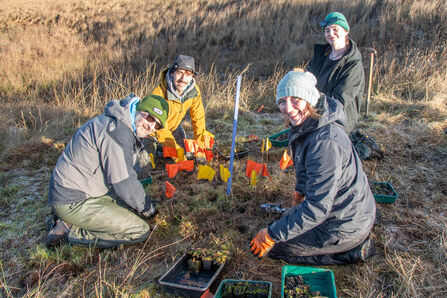
Photo credit: Sara Spillett
What skills have you picked up since you’ve been volunteering? How have they helped your confidence and ‘green’ CV?
Each of the Wild Ingleborough volunteering roles brought its own opportunities to learn invaluable new skills. The practical experience and knowledge I learned from both Wild Ingleborough staff and fellow volunteers, particularly in propagation of threatened native heritage wildflowers, has been transferred into positive actions at home.
I was inspired to collect locally sourced wildflower seeds and produce a single tray of plug plants. By 2024 one tray had mushroomed into a pallet of trays and by 2025 I had a started up a small not-for-profit venture ‘Bee Friendly Wildflowers’, with my partner Natalie. In 2025 we have donated 500+ melancholy thistle plug plants to local community projects and our aim is to see populations of this stunning upland wildflower thriving again on as many local grass verges, churchyards and meadows as possible.
Our own garden wildlife has also benefited from the wildflower propagation and plug planting skills learnt on Wild Ingleborough. In 2025 we gained a Yorkshire Wildlife Trust Wildlife Gardening Award ‘Gold’ award.
All volunteering opportunities have a comprehensive induction, training and support to use conservation tools and equipment safely.
What do you enjoy about volunteering? Do you have any particular memories or experiences you can share?
My greatest enjoyment is the satisfaction of completing the day’s task. I know that even in a small way I have positively contributed to helping Wild Ingleborough restore a little bit more space for nature. Particular highlights include:
- Two of my favourite species are on Wild Ingleborough’s recovery list: the curlew bird and melancholy thistle wildflower.
- A guided walk on Ashes Pasture introduced me to up to ten species of orchid.
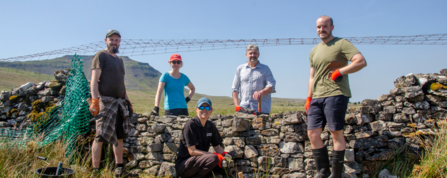
- The satisfaction of completing a day’s dry-stone walling. The group might have only done a few metres, but the wall will still be standing long after we are not!
- Whenever I climb Ingleborough through the National Nature Reserve (from Chapel-le-Dale), it is a great feeling to point out to my companion walkers that I helped plant those trees just off the path.
- In 2025, planting melancholy thistle plugs that I had actually grown myself from seed given to me in 2023, as part of the nursery plant grower project.
- All my volunteering has been achieved working with friendly Wild Ingleborough staff and fellow volunteers who share my passion, even during one particularly inclement tree planting day when we had lunch whilst huddled inside a survival bivouac!
- Oh, and did I mention all these great memories all took place amongst the beautiful Ingleborough landscape!
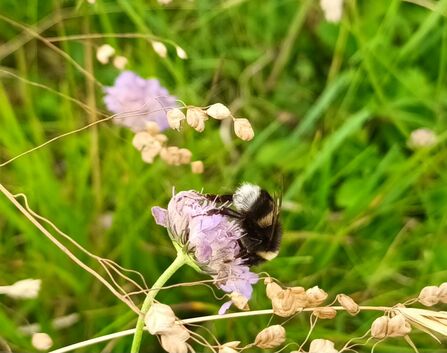
Credit: Paul Whitaker
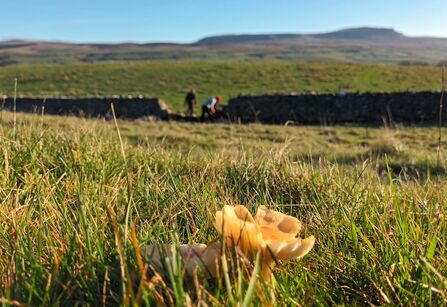
Credit: Paul Whitaker
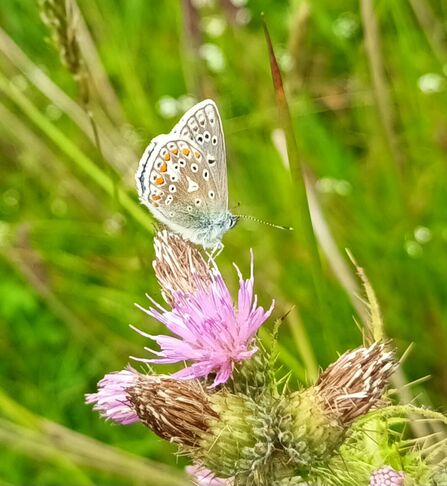
Credit: Paul Whitaker
What would you say to people who are thinking of volunteering but are a bit nervous about joining in?
Volunteering opportunities are so varied, there will always be something that you will enjoy. The tasks can be as physical or as technical as you want them to be. There is no expectation to complete tasks.
Many people volunteer for different reasons and those that I have asked agree that volunteering has made a positive impact on their health and wellbeing.
Wild Ingleborough project assistant Dwayne Martindale shares his thoughts on volunteer health and wellbeing here.
The number of volunteering opportunities allow flexibility to pick and choose roles to fit around your work/life balance.
You get full training of new skills and equipment from qualified staff. Health and safety are at the forefront of every task day.
What would be your message to people who are not sure how they can help out with the environment?
Getting ‘eco-anxious’ is understandable, especially when looking at the bigger picture of climate change. But remember all our small actions, like volunteering for Yorkshire Wildlife Trust, will actually make a difference.
I believe we can all help out with the environment. So why not have a look at the volunteering opportunities page on Wild Ingleborough website . Sara Spillett one of Yorkshire Wildlife Trust’s “Telling Our Story” Volunteers, has visited Wild Ingleborough many times and produced some really insightful volunteering blogs.
And if you have any more questions, please speak to the Wild Ingleborough staff who will be more than happy to answer them.
What are your thoughts on the future of wildlife on and communities around Wild Ingleborough and Yorkshire?
I am generally ‘half-pint-full’ by nature and so do see positive results not only of my volunteering actions, but also of the tireless work of Yorkshire Wildlife Trust and other conservation organisations.
I do think it’s all our small actions that make a difference, so it is crucial Yorkshire Wildlife Trust continue to engage more local communities. The more people engaged and involved in community led projects, the more positive change there will be for nature. This does not have to be on the scale of Wild Ingleborough. A wildlife garden or even a window box is a great starting point.
The Wild Ingleborough project team are doing fantastic work creating a biodiverse oasis of calm and tranquillity sometimes just metres away from the passing hordes of 3 Peakers. On a personal level, I am very proud help them ensure Wild Ingleborough is around for future generations. It is a cliche, but I will conclude with an old Greek proverb that for me sums up volunteering for me Wild Ingleborough:
"A society grows great when old men plant trees whose shade they know they shall never sit in.”