
The Yorkshire Dales is renowned for its unique limestone pavements and calcareous grasslands, which are a botanist’s delight. Some of our limestone-loving species are in need of a helping hand, to link up isolated populations and establish new ones in appropriate habitats.
Restoring Ingleborough’s Rare Limestone Flora

Planted spiked speedwell flowering on Ingleborough NNR summer 2026. Credit - Liz Coates
Hear the most recent updates from our upland nursery in this blog from Liz Coates, Wild Ingleborough Project Officer.

Abseiling to collect seed of Spiked speedwell. Credit: Andrew Hinde
One of these species is spiked speedwell (Veronica spicata), so scarce within the UK it has an extra level of protection by law (Schedule 8), requiring a licence to collect seed and grow this beautiful plant.
Ingleborough is one of only a handful of locations in Yorkshire where it grows. Its population of approximately 50 plants exists precariously on one small cliff ledge, requiring rope access to collect its seed.
Having first collected seed in 2023, we have now established 100 plants in our nursery to provide us with a seed source for growing the species into the future. In October we planted out 400 spiked speedwell plants onto Ingleborough NNR, as well as trialling some direct seeding as an additional restoration technique.
In June 2026 Robyn Wrigley, Research Assistant with the University of Leeds, monitored the planting and recorded an overall survival rate of 83%, with 58% of those flowering, producing 364 flowering spikes in total. Invertebrates have been seen busily pollinating these, so we look forward to observing how quickly the speedwell spread through natural regeneration going forward. These results will help inform how we grow plants in the nursery, as well as how we plan our restoration work in the future.
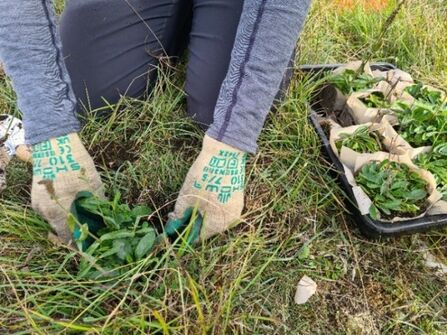
Planting out spiked speedwell plants grown in the nursery, autumn 2025. Credit - Liz Coates
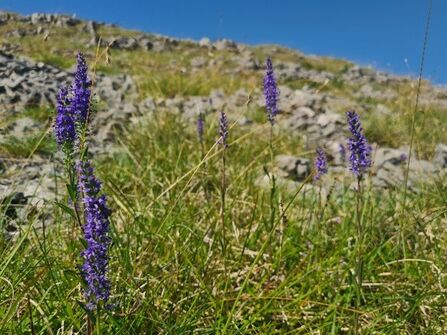
Planted spiked speedwell flowering on Ingleborough NNR summer 2026. Credit - Liz Coates
In December 2025 we sent a sample of spiked speedwell seed from our nursery grown plants to Kew Gardens Millenium Seedbank to help safeguard this species and contribute to future research and restoration.
Purple saxifrage (Saxifraga oppositifolia) is a rare montane plant that can only be found on two mountains in the Yorkshire Dales, Pen-y-ghent and Ingleborough, and was first recorded in the UK on Ingleborough in 1668. As a montane species it grows at altitude, above 600m on Ingleborough, and is a slow growing species. Our first seedlings germinated in spring 2025, and out of 100 seedlings potted on that year we selected a dozen plugs which were large enough to plant out in spring 2026, trialling planting locations. We hope to have more ready to plant out this autumn.

Purple Saxifrage in flower. Credit - Liz Coates
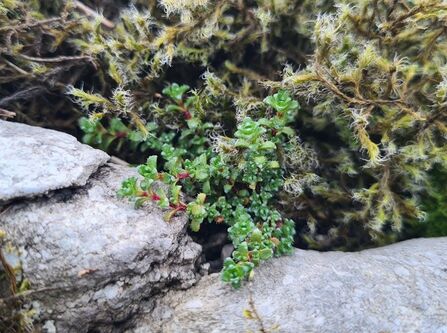
Planted purple saxifrage. Credit - Liz Coates
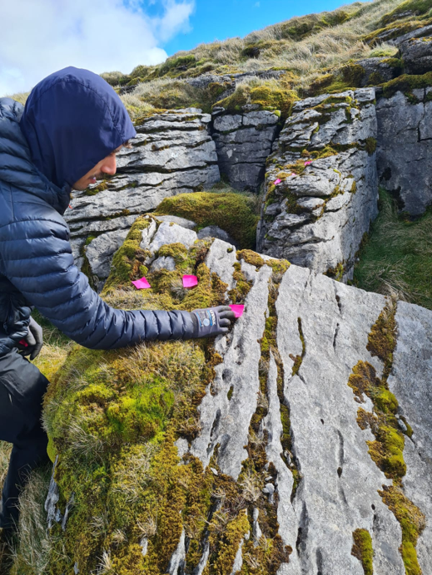
Wild Ingleborough Project Assistant, Jonath, planting nursery grown purple saxifrage. Taking photos at the time of planting, that include obvious markers, helps us record and re-find locations, in combination with GPS, for future monitoring. These markers are not left in place.
Credit - Liz Coates
Ferns have provided an interesting challenge. We are currently focussing on two specialist limestone species, limestone fern (Gymnocarpium robertianum) and holly fern (Polystichum lonchitis). Both are susceptible to over-grazing, with holly fern currently only known of in one area of limestone pavement on Ingleborough.
We’re trialling direct spraying as well as growing plants in the nursery. Both approaches require the collection of leaves, which are then left for several days to drop their dust-like spores onto paper. For direct spraying these spores are mixed with water and sprayed directly into suitable crevices in limestone pavement. These areas will be monitored to see if this approach works and how successful it is. We are also growing them in the nursery, although they are a little fussy about having a sterile environment initially to allow the gametophtyes, the first stage of their development, to establish without any competition from other spores in the environment, such as mosses or fungi. In time we’ll see which approach is most effective and efficient for restoration efforts.
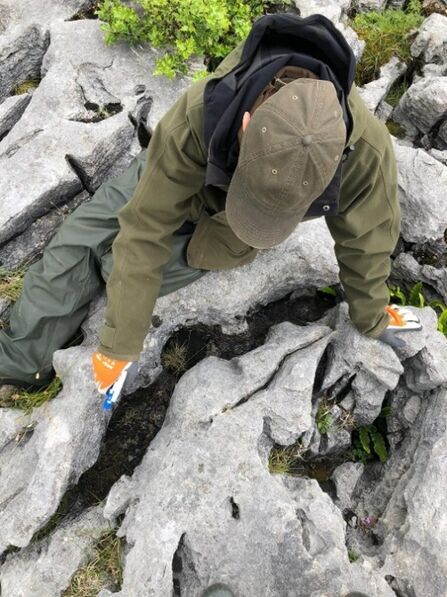
Dwayne Martindale direct spraying holly fern spores. Credit - Jo Carr
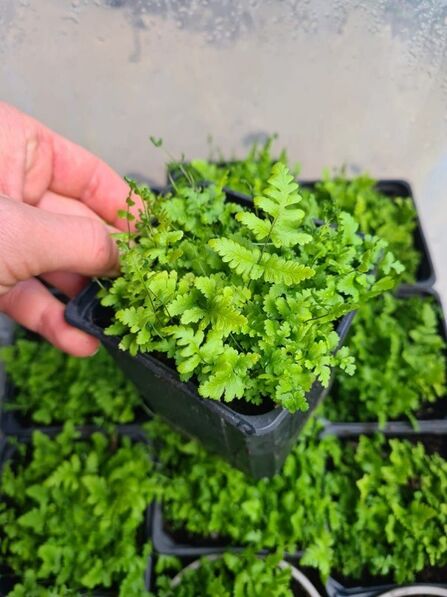
Young limestone ferns in the nursery. Credit - Liz Coates